Best Smartphone Market Share Countries (2026 Insight on Market Growth, and Digital Shift)
In today’s world, smartphones are no longer just devices for calls and social media, they have become part of everyday survival, from banking and business to entertainment and learning. What is shaping the 2026 smartphone market is not just brand popularity, but how deeply each phone fits into the financial reality of users, especially in a country where affordability still decides what most people can access.
One major shift in the market is how buying a smartphone is no longer always a one-time cash decision. With the rise of fintech, installment payment systems, and buy-now-pay-later services, more users are now able to access devices they normally wouldn’t afford upfront. This change has also pushed competition between smartphone brands and financing platforms, making the market more dynamic than before.
At the same time, global and Chinese manufacturers have fully adapted to the Nigerian reality, where strong battery life, dual SIM support, durability, and pricing matter more than luxury design. Because of this, brands like Tecno, Infinix, and Samsung have continued to dominate while others struggle to stay relevant.
Nigeria Smartphone Market Structure in 2026
The Nigerian smartphone market in 2026 is heavily shaped by affordability, import costs, and consumer income levels. Most active users fall within the ₦80,000 to ₦450,000 price range, which has now become the true competitive zone for brands.
At the top of the structure are budget devices that dominate rural and entry-level users. The middle segment is where most urban users compete, especially students, young professionals, and small business owners. The premium segment, dominated by iPhones and flagship Samsung devices, remains small but highly visible.
What makes Nigeria unique is that market leadership is not controlled by luxury appeal but by practical usage and resale value retention.
Tecno Leading the Nigerian Smartphone Market
Tecno continues to hold the strongest position in Nigeria’s smartphone space in 2026, controlling roughly 30% to 35% of usage depending on region and distribution strength.
The brand’s success is not accidental. Tecno focuses directly on African usage behavior, offering features that align with local needs such as strong battery capacity, dual SIM functionality, and cameras optimized for everyday conditions. Another strong advantage is its massive offline presence, with availability in almost every local phone market across the country.
Pricing also plays a major role, with most Tecno devices falling between ₦30,000 and ₦150,000, making it accessible to a wide consumer base. Its presence in both rural and urban markets keeps it consistently ahead of competitors.
Infinix and the Youth Market Control
 Infinix holds the second strongest position in Nigeria’s smartphone ecosystem, controlling around 25% to 30% of the market.
Unlike Tecno, Infinix focuses more on younger users who want better performance without crossing into expensive flagship pricing. The Note and Hot series are widely used for gaming, content creation, and social media.
With pricing between ₦50,000 and ₦150,000, Infinix successfully sits in the middle of affordability and performance. Its marketing strategy heavily relies on influencers and music culture, which connects strongly with Nigerian youth.
Samsung and the Premium Stability
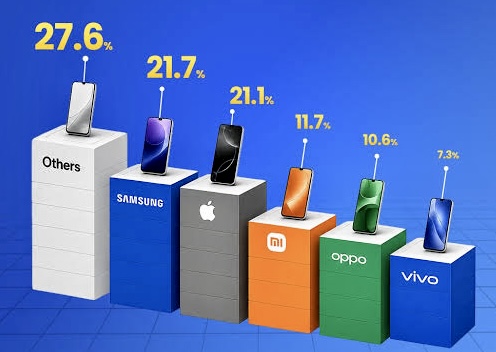
Samsung holds about 15% to 20% of the Nigerian smartphone market, maintaining a strong position in both mid-range and premium segments.
The Galaxy A and M series compete directly with Chinese brands in affordability, while the S series dominates the premium space. Prices range from ₦80,000 for entry models to over ₦800,000 for flagship devices.
Samsung’s strength in Nigeria is not just performance but trust and service structure. Its official service centers and brand reputation make it a preferred choice for users who want reliability and long-term device support.
However, Samsung still faces pressure from cheaper Chinese competitors in the mass market.
Itel and the Ultra Budget Segment
Itel plays a very important role in Nigeria’s entry-level smartphone ecosystem, capturing about 10% to 15% of users.
The brand focuses on affordability above everything else, with devices typically priced between ₦20,000 and ₦150,000. These phones are commonly used by first-time smartphone users, traders, and low-income earners.
While the specifications are basic, the availability and pricing make Itel a consistent seller across local markets.
Apple iPhone and the Luxury Market Segment
Apple iPhones control a smaller share of about 3% to 5% in Nigeria, but their influence is strong in urban elite circles.
With prices ranging from ₦500,000 to over ₦2,000,000, iPhones are mainly used by professionals, business owners, and high-income users. The resale market also plays a big role, as older models remain highly demanded among young professionals.
Despite the small share, Apple maintains strong brand loyalty and symbolic value in Nigeria’s tech culture.
Market Control by Transsion Holdings
One of the most important realities of the Nigerian smartphone market is the dominance of Transsion Holdings, the parent company of Tecno, Infinix, and Itel.
Combined, these three brands control over 60% of the entire market. This dominance is based on deep understanding of Nigerian consumer behavior rather than global premium competition.
Their strategy focuses on affordability, accessibility, and practical features instead of luxury positioning. This has allowed them to outperform global giants in one of Africa’s largest smartphone markets.
Key Market Trends Driving 2026 Growth
Several strong trends define the Nigerian smartphone market in 2026.
The first is the shift toward mid-range devices as income levels slightly improve among urban users. Another major trend is the rise of refurbished phones, especially iPhones and Samsung flagships, which allow users to access premium devices at lower prices.
Fintech integration is also shaping buying behavior, with installment payment options making expensive devices more accessible.
Finally, battery life, durability, and network compatibility remain top priorities for most users across Nigeria.
Conclusion
The Nigerian smartphone market in 2026 is clearly defined by practicality over luxury. While premium brands maintain visibility, the real control lies with brands that understand affordability and everyday usage needs.
Tecno, Infinix, and Itel continue to dominate due to pricing strategy and deep market penetration, while Samsung and Apple maintain their positions in higher income segments.
As the market continues to evolve, one thing remains clear, smartphones in Nigeria are no longer just communication tools, but essential financial and lifestyle devices shaped by affordability, access, and real-world functionality.