AI 3D Model Generators Are Transforming Virtual Museums and Digital Heritage Preservation
Virtual museums are rapidly changing how people experience history and culture. Thanks to advances in artificial intelligence and 3D modelling, museums, schools, researchers and cultural institutions can now digitise valuable artefacts and create immersive exhibitions that are accessible from anywhere in the world.
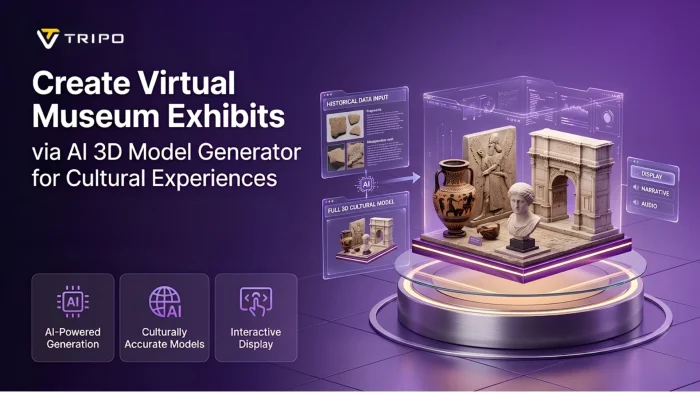
As more institutions embrace digital preservation, AI-powered 3D modelling platforms such as Tripo 3D are making it easier to recreate historical objects, preserve fragile collections and build engaging virtual exhibitions without relying on traditional modelling methods.
Virtual Museums Are Opening Cultural Heritage to the World
The rise of virtual museums has removed many of the barriers that once limited public access to cultural collections. Instead of travelling long distances, visitors can now explore museums, historical artefacts and ancient collections online from virtually any location.
Digital exhibitions also reduce the need to frequently handle delicate artefacts, helping museums preserve priceless collections while making them available to larger audiences.
Educational institutions are increasingly using virtual museums for teaching and research, while cultural organisations can showcase their collections to visitors worldwide. AI-powered 3D modelling is helping accelerate this shift by simplifying the creation of high-quality digital assets.
AI 3D Modelling Is Changing How Museums Build Digital Exhibits
Artificial intelligence has significantly reduced the time required to create realistic digital museum collections.
Modern AI 3D model generators can convert ordinary photographs into detailed three-dimensional objects, allowing museums to recreate historical artefacts even when the originals are damaged, incomplete or no longer exist.
Tasks that previously required experienced 3D artists can now be completed much faster through automated AI workflows.
Some of the biggest advantages include:
| Benefit | Impact on Museums |
|---|---|
| Faster digitisation | Large collections can be converted into digital assets more efficiently. |
| High-detail reconstruction | Artefacts can be viewed from multiple angles with impressive accuracy. |
| Lower production costs | AI reduces the need for extensive manual 3D modelling. |
| Interactive experiences | Visitors can engage with exhibits beyond static images. |
| Better preservation | Digital copies help protect fragile historical objects. |
Tripo 3D Offers Powerful Features for Digital Heritage Projects
Tripo 3D includes several AI-powered tools designed to simplify virtual museum development.
Among its key capabilities are:
- AI image-to-3D model generation
- Text-to-3D creation for conceptual exhibits
- High-quality texture generation
- Clean mesh topology for editing and animation
- Multiple export formats for various exhibition platforms
- Flexible texture quality options, including 2K, 4K and 8K
These features allow museums with limited 3D modelling experience to create professional-looking digital collections suitable for educational and interactive exhibitions.
How Museums Can Create AI-Powered Virtual Exhibits
Creating digital museum content with AI follows a straightforward workflow.
Upload Images or Describe the Artefact
Users begin by opening Tripo 3D and selecting the Model section.
From there, they can either:
- Upload photographs of an artefact
- Drag and drop image files
- Use the Text-to-Model feature to describe an object that needs to be generated
Configure the AI Generation Settings
Once the reference material has been added, users can customise various settings, including:
- AI-assisted model generation
- Texture quality (2K, 4K or 8K)
- PBR material rendering
- Quad or Triangle mesh topology
- Polygon count
- Preferred AI model version
Premium users also have access to advanced features such as 8K textures, Generate in Parts and private model generation.
Export the Finished Museum Exhibit
After the AI completes the model, users can preview it using different viewing styles, including:
- Solid View
- Cartoon Style
- Sketch Style
- Hologram Style
- Unlit Mode
The final model can then be exported in different resolutions and formats for use in virtual museums, educational software or interactive exhibitions.
AI Makes Cultural Experiences More Interactive
AI-generated 3D assets are helping museums move beyond traditional displays by creating experiences that encourage exploration and interaction.
Some of the biggest benefits include:
- Interactive viewing of historical artefacts
- Better historical reconstruction
- Virtual exhibition halls accessible worldwide
- Rich educational storytelling
- Support across multiple devices
- Long-term digital preservation of cultural heritage
Instead of simply viewing photographs, visitors can explore digital artefacts from different angles, improving engagement and making historical education more immersive.
Historical Collections That Benefit From AI 3D Reconstruction
AI-powered reconstruction supports a wide variety of museum collections.
Examples include:
- Ancient tools
- Traditional weapons
- Pottery
- Household objects
- Musical instruments
- Cultural sculptures
- Ceremonial artefacts
- Historic monuments
- Architectural structures
- Decorative heritage pieces
This flexibility allows museums to digitise collections from different historical periods while preserving important cultural details.
Optimising Digital Exhibits for Virtual Museums
Creating a realistic 3D model is only part of the process.
Museums must also optimise digital assets to ensure they perform smoothly across different exhibition platforms.
Important optimisation practices include:
- Maintaining historical accuracy
- Reducing unnecessary geometry
- Using high-quality but efficient textures
- Ensuring compatibility with real-time rendering systems
- Exporting files in platform-supported formats
Well-optimised assets deliver a better viewing experience without sacrificing visual quality or historical authenticity.
AI Will Continue Shaping the Future of Cultural Preservation
Artificial intelligence is expected to play an even larger role in digital heritage preservation over the coming years.
Future improvements may enable museums to reconstruct damaged artefacts with greater accuracy, recreate lost historical environments and build even more immersive educational experiences.
As AI technology continues to evolve, virtual museums are likely to become richer, more interactive and accessible to audiences around the world.
For museums, researchers and educators, AI-powered 3D modelling is becoming an increasingly valuable tool for preserving history while making cultural heritage available to future generations.