KNDS Delays Planned IPO as Investors Question Europe’s Defence Industry Growth Strategy
Europe’s booming defence industry is facing growing skepticism from investors after major Franco-German defence manufacturer KNDS decided to postpone its highly anticipated initial public offering (IPO).
The move comes despite record military spending commitments across Europe, raising fresh questions about whether the continent’s defence companies can deliver on ambitious expansion plans and justify the soaring valuations seen over the past few years.
KNDS Suspends Stock Market Debut Amid Global Market Uncertainty
KNDS confirmed that it has delayed plans to launch its stock market listing on the Frankfurt and Paris exchanges due to worsening market conditions and increasing geopolitical uncertainty.
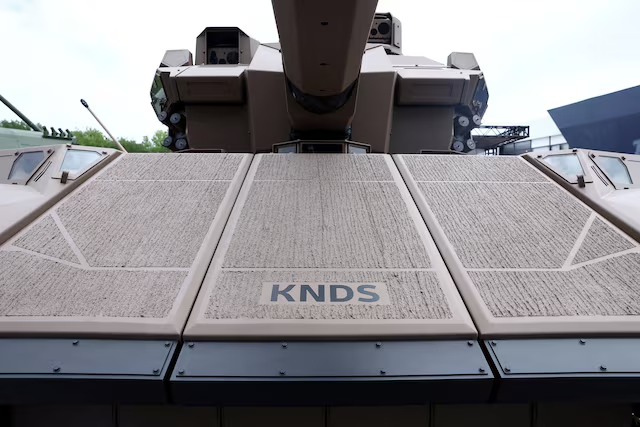
The defence company, which produces military equipment including tanks, artillery systems, and armored vehicles, had been preparing to go public within weeks. However, recent global tensions, including the escalating conflict involving Iran and broader market volatility, forced management to reconsider the timing of the offering.
The postponement is viewed by analysts as more than just a reaction to short-term market fluctuations. It also reflects growing investor concerns about the future profitability and operational capabilities of Europe’s rapidly expanding defence sector.
Financial markets have become increasingly cautious about large public offerings, particularly in industries facing substantial production and execution challenges.
European Defence Stocks Have Lost Their Momentum in 2026
The delay arrives during a difficult year for many of Europe’s largest defence companies.
After several years of explosive growth driven by increased military spending following Russia’s invasion of Ukraine, defence stocks across Europe have experienced significant corrections in 2026.
| Company | Estimated Stock Performance in 2026 |
|---|---|
| Rheinmetall | More than 30% decline |
| CSG | Over 57% decline |
| Renk | Double-digit losses |
The sharp pullback has prompted investors to reassess whether defence manufacturers can realistically fulfill their growing order books while maintaining strong profitability.
Although governments across Europe continue to announce larger defence budgets, financial markets are becoming increasingly focused on execution rather than expectations.
Production Bottlenecks Raise Questions About Industry Capacity
One of the biggest concerns affecting investor confidence is whether European defence manufacturers can expand production quickly enough to meet unprecedented demand.
Many companies currently hold record order backlogs worth billions of euros. However, industry experts warn that supply chain disruptions, manufacturing constraints, labor shortages, and delivery delays remain significant challenges.
Recent events have reinforced those concerns. Shares of German defence giant Rheinmetall came under pressure after changes to Germany’s delayed F126 frigate program raised fresh questions about project execution risks.
Investors who previously viewed defence companies as guaranteed beneficiaries of rising military spending are now demanding stronger evidence that these firms can successfully deliver on their commitments.
Modern Warfare Is Changing Faster Than Many Investors Expected
The ongoing conflicts in Ukraine and the Middle East have also reshaped perceptions about the future of military technology.
The increasing use of relatively low-cost drones, autonomous systems, and artificial intelligence-powered weapons has led some investors to question whether traditional military equipment such as tanks and armored vehicles will remain as strategically important in future conflicts.
This shift in thinking has introduced additional uncertainty into defence stock valuations.
However, military analysts caution against assuming that conventional weapons systems will become obsolete. Instead, they argue that future warfare will likely depend on a combination of traditional armored platforms and emerging technologies.
The growing integration of drones, AI systems, and autonomous weapons is expected to complement rather than completely replace conventional military assets.
NATO’s Push for Higher Military Spending Continues
Despite recent market setbacks, the long-term outlook for Europe’s defence sector remains largely positive.
Rising geopolitical tensions and continued pressure from the United States are expected to push NATO members toward significantly higher defence spending targets over the coming years.
Several alliance members are already preparing additional procurement programs and military investment packages as Europe undertakes its largest defence expansion in decades.
At the same time, government officials have reportedly expressed frustration over the pace at which defence manufacturers have increased production capacity, arguing that industry expansion has not kept pace with political commitments.
When Could KNDS Return to the Stock Market?
KNDS has not announced a new timeline for its IPO.
Financial analysts believe the company may postpone its market debut until conditions improve significantly, with some forecasts suggesting that an IPO may not occur until late 2026 or even 2027.
Several factors could influence the company’s eventual decision, including:
- Improved geopolitical stability
- Stronger performance among European defence stocks
- Greater investor confidence
- Expanded manufacturing capacity across the defence sector
- Reduced uncertainty surrounding military procurement programs
KNDS was created through the merger of Germany’s Krauss-Maffei Wegmann and France’s Nexter. The company remains jointly controlled by the French government and German family shareholders.
Reports indicate that some shareholders had planned to reduce their ownership stakes through the public offering, but current market conditions and lower sector valuations appear to have delayed those plans.
Europe’s Defence Industry Faces Its First Major Investor Reality Check
The postponement of KNDS’s IPO highlights a growing shift in investor sentiment toward Europe’s defence industry.
While governments continue committing hundreds of billions of euros to military modernization, investors are becoming less willing to rely solely on political promises and future growth projections.
Instead, markets are increasingly demanding evidence that defence manufacturers can transform record order books into sustainable profits while adapting to the rapidly changing nature of modern warfare.
Europe’s defence boom is far from over, but the era of automatic investor enthusiasm may be entering a new and more challenging phase.