Iran Reportedly Orders Houthis to Prepare Red Sea Shutdown if US Targets Power Grid
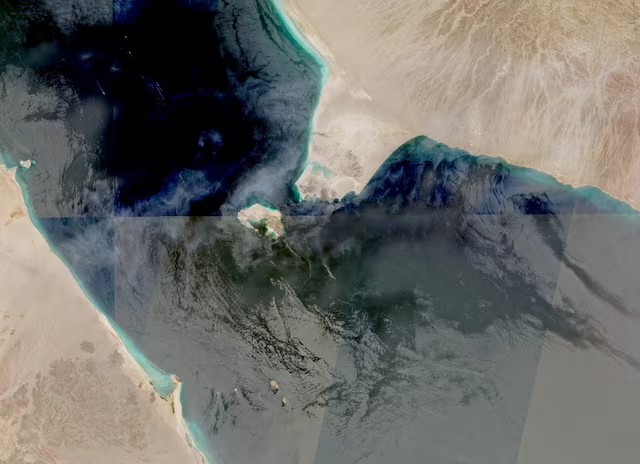
Iran has reportedly instructed Yemen’s Houthi movement to prepare for the possible closure of the Bab el-Mandeb Strait if the United States launches attacks on Iranian power infrastructure, according to multiple sources familiar with the discussions.
The reported move signals a significant escalation in regional tensions and raises fresh concerns about global oil supplies, as both of the Middle East’s key energy export routes could face simultaneous disruption.
Iran Signals Houthis to Prepare for Red Sea Operation
According to three sources familiar with the matter, Iranian leaders have discussed using their Houthi allies to block the Bab el-Mandeb Strait, one of the world’s most strategically important shipping corridors, should Washington target Iran’s electricity infrastructure.
Two senior Iranian sources and another regional source said Tehran has already communicated the request to the Houthis. The discussions reportedly took place recently, although it remains unclear whether they followed U.S. President Donald Trump’s warning earlier this week about potential strikes on Iranian power facilities.
Iran’s Foreign Ministry and Houthi representatives had not publicly commented on the report at the time of publication.
Houthis Reportedly Await Final Orders
A source close to the Houthi movement claimed the group has already positioned missiles and drones near the Bab el-Mandeb Strait and surrounding areas overlooking Hodeidah and the Gulf of Aden.
According to the source, the forces are fully prepared and are simply waiting for authorization before launching attacks on commercial shipping.
If confirmed, such a move would dramatically increase security risks for vessels passing through one of the world’s busiest maritime trade routes.
Dual Threat to Global Energy Markets
The Bab el-Mandeb Strait connects the Red Sea to the Gulf of Aden and serves as a crucial gateway for international trade and oil shipments.
The reported preparations come as the Strait of Hormuz remains closed following the ongoing conflict involving Iran, Israel, and the United States.
With Hormuz already unavailable, any disruption in the Red Sea would effectively impact both of the region’s primary oil export routes at the same time.
| Key Shipping Routes | Current Situation | Potential Impact |
|---|---|---|
| Strait of Hormuz | Already closed | Major reduction in Gulf oil exports |
| Bab el-Mandeb Strait | Under threat | Additional disruption to Red Sea shipping |
| Combined Effect | Both routes affected | Greater pressure on global oil and energy markets |
Energy analysts warn that simultaneous disruption of both waterways could deepen the ongoing global energy crisis and increase transportation costs worldwide.
Iranian Revolutionary Guard Reportedly Overseeing Operations
The Houthi source also claimed members of Iran’s Islamic Revolutionary Guard Corps (IRGC) already operating inside Yemen would determine when any operation to block the Bab el-Mandeb Strait begins.
Iran has long denied directly controlling Houthi military operations, although the United States has repeatedly accused Tehran of supplying the group with weapons, funding, intelligence, and military training.
Saudi Arabia Watching Developments Closely
Regional sources familiar with Saudi Arabia’s position said Riyadh is treating the reported threats with extreme seriousness.
Officials reportedly believe the Houthis are now coordinating more closely with Iran regarding operations affecting Red Sea shipping.
The tensions have intensified after the Houthis launched missiles toward Saudi Arabia earlier this week, accusing the kingdom of bombing an airport under their control. The attack effectively ended a four-year period of relative calm between both sides.
Oil Export Routes Face Growing Pressure
Since the closure of the Strait of Hormuz, Saudi Arabia has redirected a significant portion of its crude exports through pipelines leading to the Red Sea port of Yanbu.
Industry estimates indicate the Red Sea now handles approximately 7% of global energy supplies, making its security increasingly important for international markets.
| Energy Route | Importance |
|---|---|
| Strait of Hormuz | Previously carried about one-fifth of global energy supplies before its closure |
| Red Sea Corridor | Currently transports around 7% of global energy supplies |
| Yanbu Export Terminal | Handles a large share of Saudi Arabia’s redirected oil exports |
Analysts say any attacks targeting ports, tankers, or energy infrastructure along the Red Sea could trigger further spikes in oil prices while disrupting international shipping schedules.
Shipping Industry Faces Renewed Uncertainty
During previous Houthi attacks linked to the Gaza conflict, several global shipping companies rerouted vessels around the Cape of Good Hope in southern Africa to avoid the Red Sea.
That alternative route significantly increased transit times, fuel costs, insurance premiums, and freight expenses.
Security experts warn a renewed campaign against commercial shipping would likely force another wave of costly diversions, adding further strain to already fragile global supply chains.
Torbjorn Solvedt, Principal Middle East Analyst at Verisk Maplecroft, said any escalation involving Red Sea shipping infrastructure would come at a particularly sensitive moment for global energy markets.
He warned that intensified fighting could threaten the only major alternative route available for Gulf oil exports while the Strait of Hormuz remains inaccessible.
Regional Conflict Continues to Escalate
The latest developments stem from a conflict that escalated on February 28 after Israel and the United States launched military strikes against Iran.
The confrontation prompted Tehran to close the Strait of Hormuz, a move that severely disrupted global energy flows.
Although a temporary truce between Tehran and Washington was reached in June, that ceasefire has since collapsed, reviving fears of a broader regional war.
Iran considers the Houthis part of its regional “Axis of Resistance,” alongside Lebanon’s Hezbollah and several Iraqi Shi’ite armed groups. While those groups have been linked to various operations during the conflict, the Houthis have not officially declared full participation in the wider confrontation.