Nigeria’s Telecom Sector at 25: From GSM Revolution to the Next Digital Growth Era
Twenty-five years after the first GSM licences transformed the way Nigerians communicate, the country’s telecommunications industry has grown from a luxury service into one of the foundations of everyday life.
What started with expensive SIM cards, limited coverage and costly calls has evolved into an ecosystem powering banking, e-commerce, entertainment, education, logistics and countless businesses.
But as Nigeria marks 25 years of GSM, the industry faces a new question: what comes after the revolution?
From N30,000 SIM Cards to More Than 300 Million Connected Lines
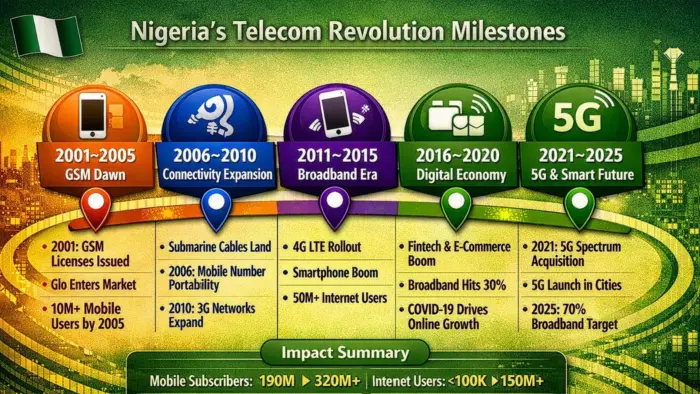
When GSM licences were issued in 2001 under the administration of former President Olusegun Obasanjo, Nigeria had fewer than half a million fixed telephone lines, largely controlled by the now-defunct Nigerian Telecommunications Limited (NITEL).
The arrival of private mobile operators changed that almost overnight.
The licences attracted about $285 million in payments, while the Nigerian Communications Commission (NCC), then led by Dr Ernest Ndukwe, oversaw the industry’s early expansion.
Within four years, mobile subscriptions had surpassed 20 million. By 2010, the figure had crossed 80 million.
Today, Nigeria has more than 320 million connected lines, although active subscriptions stood at about 189 million as of May 2026.
For millions of Nigerians, the mobile phone has gone far beyond making calls. It has become a banking channel, classroom, office, marketplace and essential connection to the wider world.
Telecoms Have Become a Major Engine of Nigeria’s Economy
The telecommunications industry now contributes more than 12 per cent to Nigeria’s Gross Domestic Product (GDP) and has become deeply connected to almost every part of the digital economy.
The sector supports jobs ranging from engineers and network technicians to customer service workers, device sellers, recharge vendors and mobile money agents.
Major operators and infrastructure companies, including MTN, Airtel, Globacom, 9mobile, MainOne, Spectranet, IHS, ipNX, ntel, ATC, Mobitel and Broadbased Communications, have all played roles in building Nigeria’s communications infrastructure.
More importantly, telecoms have created the foundation for industries that barely existed at scale before the GSM era.
Nigeria’s fintech boom, expanding e-commerce market, digital entertainment industry and logistics sector all depend heavily on reliable connectivity.
The numbers underline the scale of that transformation. Nigeria now has more than 145,000 telecom base stations supporting 2G, 3G, 4G and 5G services, alongside about 101,000 kilometres of fibre infrastructure.
Data consumption has also surged, with more than 15 million terabytes consumed over the past 17 months, reflecting how quickly Nigerians have moved from voice calls to data-driven services.
The Growth Has Come With Serious Gaps
Despite the impressive expansion, Nigeria’s telecom story is far from complete.
Millions of people, particularly in rural communities, still struggle with poor or nonexistent mobile coverage.
Estimates from government agencies have put the number of Nigerians living in unserved and underserved communities in the tens of millions. Although the figure has fallen considerably over the years, thousands of communities still lack dependable basic connectivity.
The problem is not limited to coverage.
Operators continue to face high energy costs as they rely heavily on diesel and other power solutions to keep network infrastructure running. Fibre cuts, insecurity, vandalism, multiple taxes and expensive Right of Way charges also add pressure to the cost of maintaining and expanding networks.
For consumers, the result is often familiar: dropped calls, slow data speeds, network congestion and inconsistent service.
Cybersecurity is another growing concern, with SIM-related fraud, identity theft and other forms of cybercrime threatening confidence in digital services.
5G Offers the Next Big Opportunity
Nigeria began rolling out 5G services in 2022, opening the door to faster connectivity and new digital applications.
Yet adoption remains relatively low, with 5G accounting for about 4.49 per cent of connections, according to NCC figures cited in the report.
The importance of 5G goes beyond faster smartphone downloads.
A mature 5G ecosystem could support smart-city infrastructure, telemedicine, advanced manufacturing, connected devices and other technologies that require high-speed, low-latency connectivity.
For Nigeria, however, expanding 5G must happen alongside improvements in basic broadband access.
The country’s National Broadband Plan targeted 70 per cent penetration by 2025, but that target was not achieved. By May 2026, broadband penetration stood at about 56.11 per cent, representing roughly 121 million Nigerians.
Closing that gap will require greater investment in fibre, more affordable deployment costs and stronger partnerships to extend broadband into underserved communities.
Digital Inclusion Must Go Beyond Network Coverage
Having a signal is only part of the digital inclusion challenge.
Millions of Nigerians still struggle to afford smartphones, computers and reliable data services. For low-income households, the cost of staying connected can remain a significant barrier even where network coverage exists.
Affordable devices, community internet centres and digital literacy programmes could therefore play an important role in ensuring that connectivity translates into real economic opportunities.
Nigeria also has an opportunity to build more of the technology it consumes.
Supporting indigenous software developers, hardware assembly, digital platforms and technology startups could create jobs, strengthen local expertise and reduce dependence on imported solutions.
Telecoms Could Unlock More Growth Across Nigeria
The next stage of the industry’s development could extend far beyond traditional voice and data services.
Mobile connectivity can help expand financial services into communities that remain outside the formal banking system. Farmers can use digital platforms to access market information, weather updates and financial products, while healthcare providers can use connectivity to improve access to medical information and services.
Government services could also become more efficient through digital identification, electronic records and mobile platforms.
At the same time, Nigeria’s young population continues to build businesses around entertainment, education, logistics and technology.
With its huge market and growing digital workforce, the country has the potential to strengthen its position as one of Africa’s leading technology hubs.
Operators Want a More Stable Business Environment
Industry stakeholders argue that achieving the next phase of growth will require a stronger partnership between government, regulators, operators and consumers.
MTN Chief Financial Officer Modupe Kadri said the telecommunications industry is not insulated from the wider challenges affecting Nigeria’s economy.
He highlighted issues including insecurity, vandalism, fibre cuts, multiple taxation and costly Right of Way charges as obstacles that continue to affect the sector.
A more predictable regulatory environment, combined with infrastructure investment and policies that encourage long-term capital spending, could help operators expand networks and improve service quality.
Operators, for their part, will also face growing pressure to improve customer experience, strengthen sustainability efforts and invest in newer technologies.
The Next 25 Years Will Be About More Than Connectivity
Nigeria’s first 25 years of GSM were largely about connecting people.
The next 25 years could be about what those connections enable.
Telecom expert and former NITEL staff member Kehinde Aluko believes the industry must move beyond simply providing voice and data services and become a stronger platform for innovation, inclusion and economic opportunity.
That shift is already beginning.
Artificial intelligence, for instance, is creating new possibilities for telecom operators to understand customer behaviour, improve network operations, personalise services and develop new digital products.
For MTN, Kadri said the company’s future strategy must be driven by the ambitions and needs of its customers, while technologies such as AI could help improve operational efficiency and the way services are delivered.
The GSM revolution changed Nigeria by making communication accessible to millions. Its next chapter will be judged by whether that connectivity can translate into broader prosperity.
At 25, Nigeria’s telecom industry has already transformed the country. The bigger challenge now is ensuring that the next generation of growth reaches the communities, businesses and Nigerians still waiting to fully benefit from the digital economy.