Senate Committee Set to Vote on Bill That Would Tighten U.S. Ban on Chinese Vehicles
The U.S. Senate Commerce Committee is preparing to vote on bipartisan legislation that would strengthen restrictions on Chinese automakers and make it even harder for them to enter the American market.
The vote, scheduled for July 15, comes as Washington continues to tighten its stance on Chinese-made vehicles over concerns about national security, data privacy, and the future of the U.S. automotive industry.
Senate Bill Aims to Permanently Strengthen Restrictions
The legislation was introduced in April by Republican Senator Bernie Moreno of Ohio and Democratic Senator Elissa Slotkin of Michigan.
If approved, the bill would officially write into law regulations introduced by the Biden administration that effectively block Chinese automakers from selling passenger vehicles in the United States.
Lawmakers say the measure is designed to close any loopholes that could allow Chinese manufacturers to gain a foothold in the U.S. light-duty vehicle market.
New Rules Target Chinese Vehicle Technology
Beyond restricting vehicle imports, the proposed legislation would also prohibit vehicles designed in China if they include advanced connectivity systems or vehicle software that could present national security risks.
Supporters of the bill argue that modern vehicles collect vast amounts of driver and location data, creating potential security concerns if that information were accessible to foreign governments.
A similar version of the legislation has already been introduced in the U.S. House of Representatives.
Key Provisions of the Senate Bill
| Proposal | Details |
|---|---|
| Chinese vehicle ban | Reinforces restrictions on Chinese passenger vehicles entering the U.S. market |
| Connected vehicle restrictions | Bans vehicles designed in China with advanced connectivity technology |
| Software controls | Targets vehicle software viewed as a potential national security risk |
| Permanent legal framework | Converts existing government regulations into federal law |
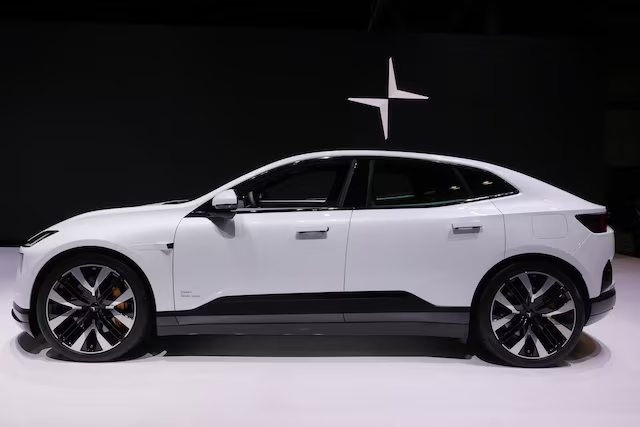
Polestar Ends U.S. Sales for Future Models
The tougher regulatory environment has already affected automakers operating in the United States.
Last month, electric vehicle maker Polestar announced it would stop selling vehicles in the U.S. beginning with the 2027 model year after actions taken by the Trump administration expanded restrictions on Chinese-linked vehicles.
The move highlights the growing challenges facing manufacturers with Chinese connections as U.S. policies become increasingly strict.
Biden-Era Regulations Laid the Foundation
The proposed legislation builds on regulations introduced by the Biden administration in January 2025.
Those rules effectively blocked Chinese automakers from selling passenger vehicles in the United States, citing concerns that connected vehicles could collect sensitive information about American drivers.
Officials warned that internet-connected vehicles are capable of gathering large amounts of personal and operational data, making them a potential cybersecurity and intelligence risk.
Auto Industry Groups Back Tougher Measures
Earlier this year, major automotive organizations representing nearly every major car manufacturer urged the U.S. government to continue preventing Chinese automakers from entering the American market.
The coalition included companies and organizations representing:
- Ford
- General Motors
- Volkswagen
- Hyundai
- Toyota
- Auto parts manufacturers
- Vehicle dealers
The industry groups argued that China’s growing automotive sector poses a significant challenge to America’s manufacturing leadership and national security.
According to the organizations, allowing Chinese automakers greater access to the U.S. market could weaken domestic production while increasing security risks tied to connected vehicle technology.
Chinese EVs Continue Expanding Globally
Despite facing steep tariffs in the United States, Chinese electric vehicle manufacturers continue to grow their presence around the world.
Lower-priced Chinese EVs have gained significant market share across Europe and Mexico, where consumers have increasingly embraced affordable electric vehicles.
Recent consumer surveys also suggest that interest in Chinese-made vehicles has been rising among some American buyers, even though the vehicles remain largely unavailable in the U.S. market.
Trump Previously Left Door Open for U.S. Manufacturing
In January, President Donald Trump indicated he could support Chinese automakers manufacturing vehicles inside the United States rather than importing them.
However, no changes to U.S. automotive policy were announced following Trump’s summit with Chinese President Xi Jinping in May.
With the Senate Commerce Committee now preparing to vote on the bipartisan bill, lawmakers appear ready to move toward even stricter legal barriers for Chinese automakers seeking access to the U.S. market.