Best Business Countries in South Asia 2026: Real Opportunities, Risks, and What Actually Works
In 2026, building a successful business in South Asia is no longer just about having capital, it is about understanding where money flows, how systems actually work on the ground, and how fast each country is adapting to global economic pressure.
The reality is that while many businesses struggle due to unstable funding, rising costs, and policy delays, others are growing faster because they are plugged into structured financial support systems like microfinance banks, fintech lending platforms, and cross-border investment channels. These tools are not just helping big corporations, they are quietly shaping small and medium businesses into scalable ventures when used correctly.
Technology is also playing a major role in this shift. Most financial systems in South Asia are now deeply connected to mobile banking and digital lending platforms. Some microfinance institutions and loan applications are even integrating smart automation tools to simplify approvals and repayments for users. This has made access to credit easier, but at the same time, it has increased the importance of understanding the risks, repayment conditions, and long-term impact before taking any financial step.
This is why a proper breakdown of the best business countries in South Asia for 2026 is important. Not just rankings, but real structure, real opportunities, and real challenges based on how each market behaves economically, politically, and commercially.
The Real Business Ranking of South Asia in 2026
Instead of surface-level rankings, what matters in 2026 is how stable the business environment is, how fast industries are growing, and how easy it is to actually operate and scale.
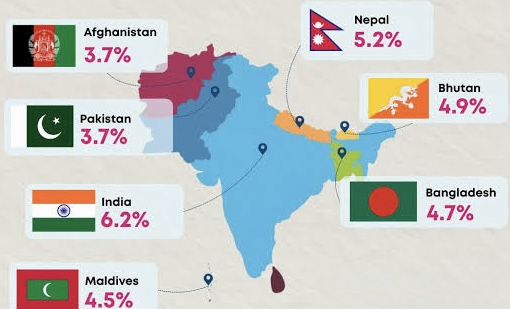
India stands clearly at the top due to its massive market size, strong digital economy, and continuous inflow of foreign investment. Even with regulatory complexity, it remains the most scalable environment in the region.
Bangladesh, despite bureaucratic pressure, continues to dominate in manufacturing, especially textiles and ready-made garments. Its export strength keeps it relevant globally even when internal systems are difficult.
Sri Lanka is gradually recovering from economic instability, and this recovery phase is creating entry points in tourism, logistics, and asset acquisition at relatively lower costs compared to previous years.
Pakistan remains high-risk but high-potential. The population size and demand structure make it attractive, but currency instability and policy unpredictability remain serious concerns.
Nepal and Bhutan operate on smaller scales but provide stable entry points for niche sectors like tourism, hydropower, and local franchises where competition is still limited.
Maldives stands completely different from the rest, focused mainly on luxury tourism and high-value services, making it a high-cost but high-return environment.
India: The Scale Market With High Competition
India continues to dominate South Asia’s business landscape in 2026. The major advantage is scale. Any product or service that succeeds in India has the potential to become a large regional business.
The strongest sectors include technology services, fintech, data infrastructure, sports-related industries, and agriculture innovation. The country is also experiencing strong movement in mergers and acquisitions, which shows that consolidation is becoming a key growth strategy.
However, entering the Indian market requires strong planning. Operational costs vary widely, and regulatory requirements can slow down expansion if not properly managed. Despite this, India remains the strongest long-term growth market in the region.
Bangladesh: Manufacturing Power With Operational Pressure
Bangladesh is one of the most important manufacturing hubs in South Asia, especially in garments and export-driven production. The country benefits from low labor costs and high production volume demand from international buyers.
However, the business environment is not smooth. Bureaucratic delays, infrastructure limitations, and regulatory complexity make operations difficult for new entrants. Even with these challenges, the country continues to attract global manufacturers due to its production strength.
In 2026, Bangladesh is improving slowly, but the real opportunity still lies in large-scale manufacturing and export partnerships rather than small retail entry.
Sri Lanka: Recovery Phase Opportunities
Sri Lanka is currently in a rebuilding stage after recent economic instability. This phase creates opportunities for investors who understand timing.
Tourism is one of the strongest recovery sectors, followed by logistics, import-export trade, and real estate acquisition. Prices in certain sectors remain lower compared to historical averages, which creates entry advantages for medium-scale investors.
The key factor in Sri Lanka is timing. Early positioning in recovery markets often leads to higher long-term returns when stability returns fully.
Pakistan: High Risk, High Demand Economy
Pakistan presents a mixed business environment. On one side, there is strong consumer demand due to a large youth population and growing urbanization. On the other side, there are challenges like energy instability, currency fluctuations, and policy uncertainty.
Sectors like energy solutions, fintech, telecom services, and basic consumer goods remain active. Businesses that solve structural problems such as electricity, payment systems, and logistics tend to perform better.
This is not a market for passive investment. It requires active management and risk control.
Nepal and Bhutan: Small but Stable Entry Markets
Nepal offers opportunities in tourism, small-scale franchises, and hydropower development. The competition is low compared to larger markets, which makes entry easier for first-time investors.
Bhutan operates in a more controlled economic system, focusing heavily on sustainability, tourism, and high-value niche sectors. Entry is more restricted, but stability is one of its strongest advantages.
Both markets are not designed for rapid scaling but for steady, controlled growth.
Maldives: Luxury-Driven Business Model
The Maldives operates on a completely different economic structure compared to the rest of South Asia. It is driven mainly by luxury tourism, hospitality, and high-end services.
The cost of entry is significantly higher, but revenue potential is also strong due to high tourist spending. Businesses that succeed here usually focus on premium experiences rather than volume-based operations.
Key Business Trends Shaping South Asia in 2026
Across the region, three major trends are shaping business decisions.
First is digital finance expansion. Mobile banking and loan applications are making credit access faster, but also increasing repayment pressure due to strict automated systems.
Second is manufacturing realignment. Countries like Bangladesh and India are benefiting from global supply chain shifts away from traditional manufacturing hubs.
Third is energy transition. Solar and renewable energy solutions are becoming critical in countries facing fuel import pressure and energy instability.
Final Insight
The real difference between successful and failed businesses in South Asia in 2026 is not just capital. It is understanding timing, market structure, and risk behavior in each country.
India offers scale, Bangladesh offers production strength, Sri Lanka offers recovery opportunity, Pakistan offers high-risk demand, while Nepal, Bhutan, and Maldives offer niche and controlled growth paths.
Anyone looking at this region must understand that no single country is perfect. Each one requires a different strategy, different entry point, and different level of risk tolerance.