JetZero Bets on Revolutionary Aircraft Design to Challenge Boeing and Airbus
The global aviation industry could be on the verge of a major shake-up as California-based startup JetZero pushes ahead with plans to develop a new generation of commercial aircraft that promises to dramatically reduce fuel consumption and reshape air travel.
The company is currently constructing a full-scale demonstrator aircraft in California’s Mojave Desert, marking one of the most ambitious commercial aviation projects in decades. If successful, JetZero’s blended-wing-body aircraft could challenge the dominance of aerospace giants Boeing and Airbus in the lucrative mid-size commercial jet market.
JetZero’s Bold Vision for the Future of Aviation
Inside a massive aircraft hangar in the Mojave Desert, engineers are building what could become the world’s first commercially viable blended-wing passenger aircraft.
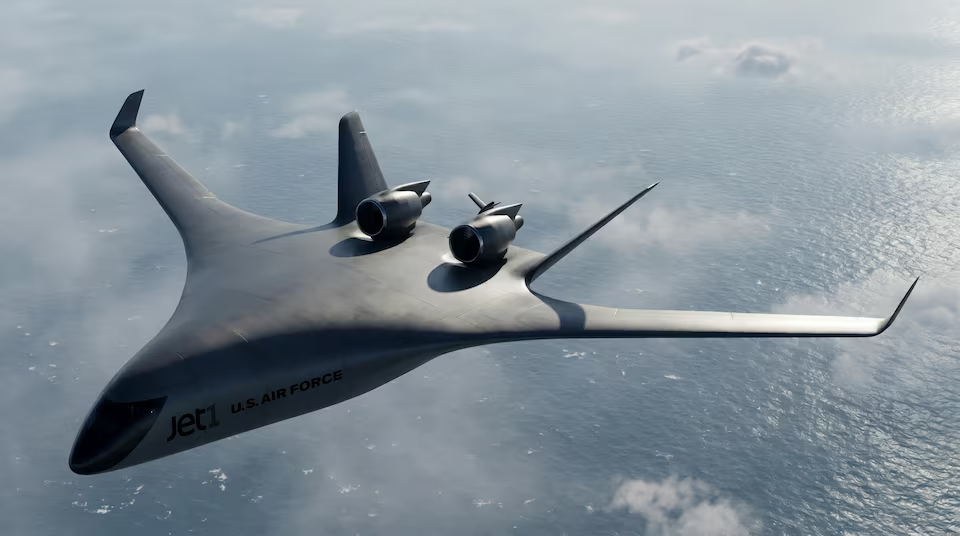
Unlike traditional airplanes, which feature a separate fuselage and wings, JetZero’s design integrates both into a single lifting surface. The aircraft’s manta ray-inspired shape is designed to significantly reduce aerodynamic drag, potentially cutting fuel consumption by as much as 50%.
The startup aims to conduct the first flight of its full-scale demonstrator by the end of 2027, a critical milestone that could determine the future of the company and its ambitious plans.
According to JetZero CEO Tom O’Leary, the project is built on decades of research rather than experimental technology.
“Nobody’s ever done this before. We’re taking existing technology and more than 30 years of NASA research,” O’Leary said.
Backed by the U.S. Air Force and Major Airlines
JetZero’s project has already attracted significant attention from both the military and commercial aviation sectors.
In 2023, the U.S. Air Force selected the company for a $235 million program to help develop and demonstrate the aircraft. The demonstrator itself is being constructed by Scaled Composites, the aerospace company owned by Northrop Grumman.
Several major airlines have also shown early interest in the concept, including United Airlines and Alaska Airlines, both of which see potential in an aircraft capable of dramatically lowering fuel costs.
JetZero Project Overview
| Category | Details |
|---|---|
| Company | JetZero |
| Founded | 2020 |
| Aircraft Type | Blended-Wing-Body Passenger Jet |
| Planned Passenger Capacity | 200–270 passengers |
| First Demonstrator Flight | Expected by end of 2027 |
| Fuel Savings Goal | Up to 50% |
| U.S. Air Force Support | $235 million |
| Planned Commercial Production | Around 2030 |
| Manufacturing Location | Greensboro, North Carolina |
Aiming to Replace the Boeing 757 and 767 Market
JetZero plans to target the market segment once dominated by the Boeing 757 and Boeing 767 aircraft.
Its proposed Z4 aircraft would carry between 200 and 270 passengers on medium- and long-haul routes, a market many analysts believe remains underserved.
The aircraft’s unique wide-body design would also allow airlines to rethink passenger experiences, with features such as:
- Larger passenger windows
- More spacious cabin layouts
- Flexible seating arrangements
- Redesigned galleys and lavatories
- Reduced cabin noise levels
The aircraft’s engines would be mounted above the rear section of the plane, helping improve fuel efficiency while also reducing noise pollution around airports.
Engineers Face Major Technical Challenges
Despite growing industry interest, aerospace experts warn that JetZero still faces enormous engineering and financial hurdles.
One of the biggest questions remains whether the blended-wing-body design can actually deliver the fuel savings and operational efficiency the company promises.
Aerospace analyst Richard Aboulafia noted that while the project once seemed unrealistic, recent progress has forced many in the aviation industry to take JetZero seriously.
However, he cautioned that moving from a successful prototype to a certified commercial aircraft remains one of the most difficult challenges in aerospace.
Certification programs for entirely new aircraft designs often take years and require billions of dollars in investment.
Military Applications Could Boost JetZero’s Chances
Some aviation experts believe JetZero’s aircraft may ultimately find its greatest success in military aviation.
Aeronautical engineer Bjorn Fehrm argues that the blended-wing-body concept naturally suits military operations due to its ability to carry larger fuel loads and cargo while potentially offering stealth advantages.
Possible military applications include:
- Air refueling tankers
- Strategic cargo transport aircraft
- Military logistics platforms
- Future stealth support aircraft
Such military contracts could provide additional funding and long-term stability for the startup.
Investors Continue to Back the Ambitious Startup
Despite the risks, investors have continued to pour money into JetZero.
Earlier this year, the company raised $175 million in funding from investors including:
- B Capital
- United Airlines Ventures
- Northrop Grumman
- RTX Ventures
As part of its investment agreement, United Airlines secured the option to purchase up to 100 aircraft, with an additional option for another 100 jets if the program proves successful.
JetZero is planning another funding round later this year and is also considering a public stock market listing by 2028.
The 2027 Test Flight Could Decide Everything
For JetZero, the upcoming full-scale demonstrator flight represents far more than a technological milestone.
A successful test flight would validate years of research, attract additional investment, and potentially open the door to firm airline orders.
Company executives believe that once airlines witness the aircraft flying successfully, confidence in the project could increase dramatically.
Until then, JetZero remains one of the aviation industry’s boldest bets, an ambitious startup attempting to achieve what neither Boeing nor Airbus has yet accomplished: bringing blended-wing commercial aircraft into mainstream passenger service.