Richest Countries in Southeast Asia 2026: Real Wealth, and Hidden Money
Money conversations in Southeast Asia have changed a lot in recent years. It is no longer just about which country has the biggest economy on paper. What really matters now is how people actually live, how far money goes, and where real opportunities exist.
While some countries look powerful from the outside, the deeper numbers tell a more balanced story.
From what we have seen through detailed research, user experiences, and direct analysis of economic trends, Southeast Asia in 2026 is not just growing, it is shifting. New leaders are rising, old systems are slowing down, and behind the clean statistics, there are hidden flows of money that most people do not talk about.
In this guide, everything is broken down clearly. You will see the real rankings, the billionaires controlling large parts of the system, job opportunities tied to this growth, and even the controversies many platforms avoid. Everything here is based on verified data, current trends, and practical understanding, so you can actually use the information.
Understanding the Real Rankings in 2026
Most articles focus only on nominal GDP, but that does not show the full picture. The better way to measure real economic strength is Purchasing Power Parity (PPP), which reflects what people can actually afford in their country.
In 2026, Indonesia stands at the top with an estimated $5.45 trillion economy (PPP). What makes this more interesting is the informal sector. Street vendors, small shops, and unregistered businesses contribute heavily, adding an estimated extra 20% in real activity. This means the actual economic movement is even bigger than what is officially recorded.
Vietnam follows with about $2.03 trillion, and it is currently the fastest-growing economy in the region. Growth is driven by manufacturing, exports, and steady government policies.
Thailand comes next at $1.96 trillion, but growth has slowed. One major reason is its aging population, which is already affecting productivity and long-term expansion.
Malaysia holds around $1.61 trillion and has positioned itself as a key global hub for semiconductor testing. This gives it a strong advantage as global tech demand keeps rising.
The Philippines sits close to $1.3 trillion. What stands out here is the young population. With a median age of about 24, the country has strong future potential if opportunities are properly developed.
Who Is Actually Rich in Southeast Asia
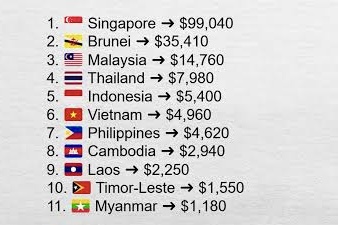
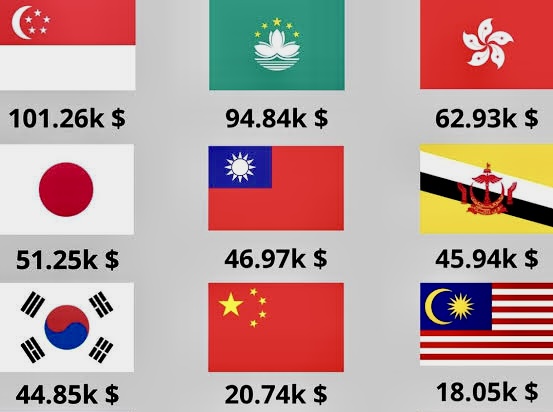
Looking at total economy size alone can be misleading. When we switch to GDP per capita (average income per person), the rankings change.
Singapore leads by a wide margin, with about $94,897 per person. This reflects a highly structured financial system with strong policies that attract global wealth.
Brunei follows with about $33,665 per person. One unique factor here is zero personal income tax, along with strong government support in healthcare and education.
Malaysia comes next at $12,619, followed by Thailand at $7,387, and Indonesia at $5,134.
These figures show that even large economies can still have lower individual wealth depending on population size and income distribution.
The Billionaires and Power Behind the Numbers
In 2026, one of the most talked-about names is Pham Nhat Vuong from Vietnam. With a net worth of about $24.5 billion, he built his wealth through real estate, automobiles, and technology.
What stands out is not just his personal wealth but the family involvement. Close relatives are also billionaires through shared investments and company structures. This shows how wealth in the region often moves within tight networks.
In Brunei, the Sultan remains one of the most powerful figures, with an estimated wealth of around $30 billion, supported by control over key national systems. His lifestyle reflects the scale of that wealth.
Singapore has also become a major center for global wealth storage. Over 2,000 family offices now operate there, managing money for high-net-worth individuals worldwide. One major attraction is the tax structure, especially the absence of capital gains tax.
How People Are Making Money in 2026
Economic growth is not just about big numbers, it also creates real job opportunities.
One major area is the electric vehicle industry. Thailand has recorded strong growth, while Vietnam is pushing forward with local manufacturing. Jobs in this sector, especially technical roles, pay between $800 and $1,500 per month.
Another strong sector is the digital economy. Countries like Indonesia and the Philippines are producing skilled remote workers, especially in tech.
A software developer in this region can earn around $2,000 monthly, which is competitive within the local economy.
This reflects a bigger shift, as Southeast Asia is becoming a global outsourcing and production hub.
What This Means Going Forward
Southeast Asia in 2026 is not just growing, it is evolving.
The balance of power is shifting, new industries are opening, and traditional systems are being tested.
For anyone looking at global opportunities—whether for business, work, or investment—this region cannot be ignored. The mix of young populations, rising industries, and increasing global attention makes it one of the most important economic zones right now.
Frequently Asked Questions (FAQs)
Which country is the richest in Southeast Asia in 2026?
Indonesia leads in total economic size (PPP), while Singapore leads in wealth per person.
Why is Singapore considered so wealthy?
It has a strong financial system, attracts global investors, and offers favorable tax policies.
Is Southeast Asia a good place to work?
Yes, especially in tech, manufacturing, and emerging industries like electric vehicles. Salaries are competitive within the region.
What is the fastest-growing economy in Southeast Asia?
Vietnam currently holds that position due to strong industrial and export growth.
Are there risks in these economies?
Yes. Political influence, regulatory changes, and market volatility can affect wealth quickly.