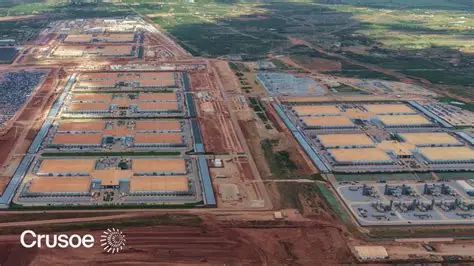
Crusoe just secured one of the largest private funding rounds the data-centre sector has seen this year. The company raised $3.9 billion in a Series F round, pushing its post-money valuation to roughly $30.9 billion. Crusoe says the money will help expand its AI infrastructure platform, including large-scale campuses and modular “AI factories.”
The timing is no accident. Power-hungry GPU clusters are putting pressure on electricity grids in traditional technology hubs, and AI infrastructure operators are hunting for sites where they can secure enough power and build capacity quickly.
Crusoe’s model has leaned heavily on energy infrastructure, including opportunities involving stranded or underused power. The new capital gives the company room to accelerate its construction plans while expanding smaller modular Crusoe Spark units that can be deployed as part of its wider AI infrastructure strategy.
Investors Are Still Pouring Money Into AI Infrastructure
Investors clearly buy the infrastructure thesis. AI training runs and inference workloads continue to grow, while traditional data-centre capacity can take years to plan and construct.
The $3.9 billion round was co-led by Atreides Management, Mubadala Capital and Valor Equity Partners. Founders Fund, GIC, Nvidia, Qatar Investment Authority, Radical Ventures and TPG were also among the investors.
Crusoe says it now has more than $140 billion in total contracted value across its vertically integrated platform. The funding will support the company’s efforts to expand from energy generation through AI cloud services.
For the network side, the implications are direct. Every new Crusoe site needs high-capacity fibre, low-latency interconnects and, in many cases, dedicated long-haul links back to major exchange points.
Telecom operators and dark-fibre providers therefore have another reason to watch the company’s expansion map. In markets where power is abundant but bandwidth is scarce, the combination of modular AI factories and new fibre builds could reshape regional connectivity patterns.
The Risks Are Still There
Critics point out the risks. Building at this scale requires long-lead equipment, skilled labour and regulatory approvals that can slip. Power markets themselves remain volatile.
Still, the sheer size of the raise shows that institutional capital continues to flow into the physical infrastructure needed to run AI systems. Crusoe is betting that the next wave of demand will reward operators capable of delivering both megawatts and megabits at scale.