
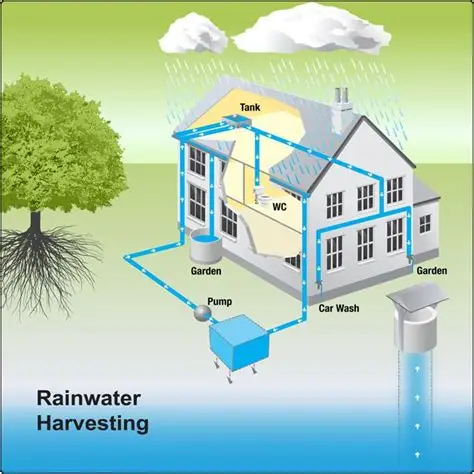
Rainwater harvesting can provide an additional source of water for cleaning, gardening, irrigation and other household uses.
A basic system can collect rainwater from a roof and direct it into a storage tank for later use. The exact design depends on the size and condition of the roof, the amount of rainfall in the area, the available storage space and what the collected water will be used for.
Proper construction and maintenance are important because poorly protected stored water can become contaminated.
Collect Water From the Roof
A simple rainwater harvesting system would usually involve the roof of the house, with gutters angled towards a downpipe instead of allowing rainwater to run off in different directions. The downpipe channels the collected water towards a storage tank where it can be kept for later use.
The roof should be kept reasonably clean because dirt and other materials can be washed into the collection system when it rains.
Gutters should also be checked regularly for leaves, mud and other debris that could block the flow of water.
The size of the roof and the amount of rainfall in the area will affect how much water can realistically be collected. A larger roof can generally provide a larger collection area, but the available storage capacity also needs to be considered.
Use a First-Flush Diverter
A first-flush diverter is also a useful addition because the first water flowing from a roof can contain dust, leaves, bird droppings and other contaminants that have accumulated on the roof.
The diverter allows the initial flow of water to be separated before cleaner rainwater enters the main storage tank.
This does not make the water automatically safe to drink, but it can reduce some of the material entering the storage system.
The first-flush component should also be cleaned and maintained so that it continues to work properly.
Protect the Storage Tank
The storage tank should be covered to prevent insects, leaves and other materials from getting inside. If possible, placing the tank on a strong raised platform can improve water pressure through gravity.
A mesh screen should be installed around the inlet to prevent leaves and insects from entering the tank. The tank should also have an appropriate overflow outlet so excess water can be safely directed away when it becomes full.
The tank should be positioned on a stable surface capable of supporting its weight when completely filled. Water is heavy, so an inadequate platform can become a serious structural problem.
Keep the area around the tank clean and inspect the tank, cover, pipes and connections regularly for damage or leaks.
Keep the Water Storage Area Clean
Rainwater harvesting systems require regular maintenance.
Gutters should be cleared of leaves and other debris, while filters and screens should be checked to ensure they are not blocked.
The inside of the storage tank may also require periodic cleaning depending on the design and how quickly sediment accumulates.
Mosquitoes and other insects should be prevented from accessing stored water. A properly fitted cover and suitable screens can help reduce this problem.
Treat Water Properly for Drinking
Rainwater can be useful for cleaning, washing, gardening and irrigation. However, water intended for drinking requires appropriate treatment and testing.
Do not assume that rainwater is safe to drink simply because it looks clear. Water collected from a roof can contain microorganisms, dust, chemicals and other contaminants.
If the water will be used for drinking, cooking or preparing food, an appropriate treatment method and water-quality testing should be considered. The treatment method should be suitable for the specific contaminants that may be present.
Where there is uncertainty about water quality, seek advice from an appropriate water or public-health professional.
Choose the Storage Tank Carefully
The storage tank should be suitable for water storage and large enough for the intended use.
A tank that is too small may fill quickly and cause large amounts of collected rainwater to be lost through the overflow. A tank that is unnecessarily large, however, may cost more and require more space and stronger structural support.
Consider how much water the household needs, how frequently it rains and how long the water may need to be stored.
Maintain the System Regularly
A rainwater harvesting system is not something that can simply be installed and forgotten.
Inspect the gutters, downpipes, screens, first-flush diverter, tank and overflow outlet regularly. Repair leaks and replace damaged components when necessary.
Regular maintenance helps the system collect water more efficiently and reduces the chances of contamination.
Rainwater harvesting can be a practical additional water source for rural homes when the system is designed, protected and maintained properly. For drinking water, appropriate treatment and testing remain essential.