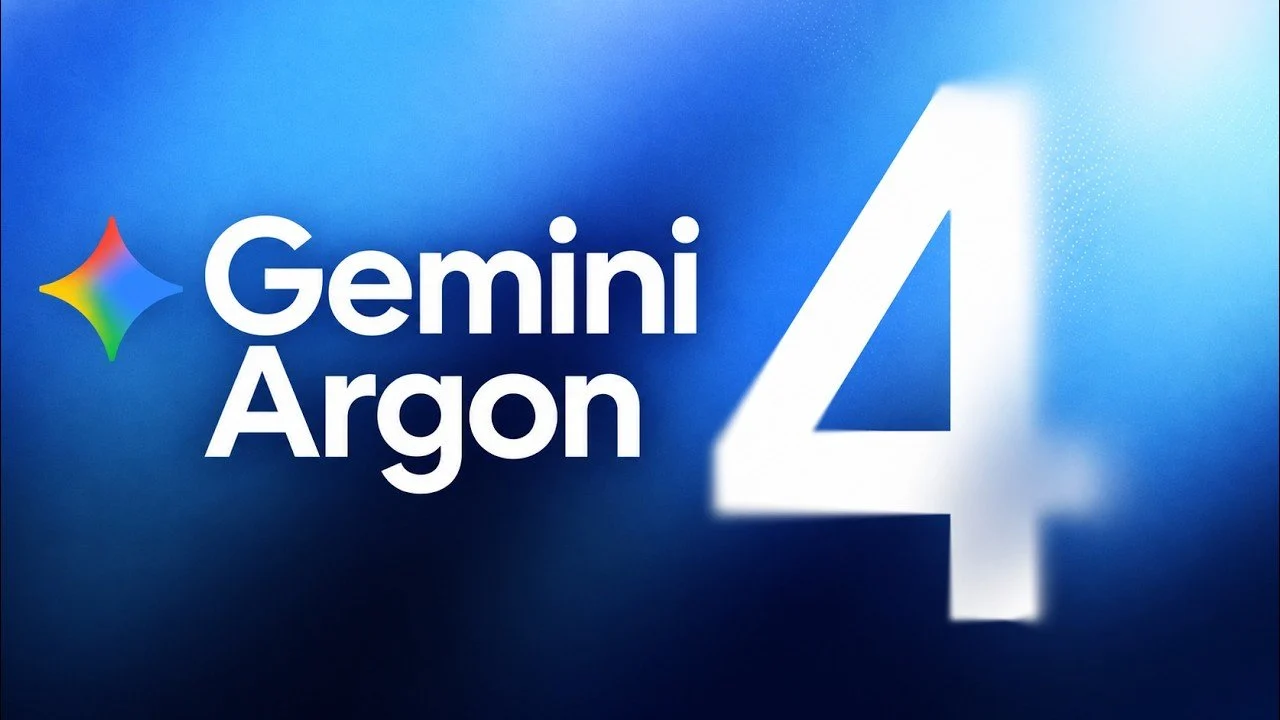
Google has concluded an eventful September with the launch of Gemini 4 Argon, which the company has positioned as its newest frontier model.
Unlike Google’s lighter Gemini models, Argon is focused heavily on complex, multi-step tasks that require advanced reasoning, coding, research and longer workflows.
The launch represents another major step in Google’s increasingly aggressive AI strategy. Rather than relying on a yearly model-release cycle, Google appears to be accelerating the pace at which it introduces new models and specialized AI capabilities.
Google says Gemini 4 Argon is designed for real-world software engineering, enterprise knowledge work and cybersecurity defense. The model is also being introduced with strong safety measures because of its capabilities in cybersecurity and autonomous technical work.
Google Is Moving Beyond Traditional Chatbots
The significance of Gemini 4 Argon is not simply that Google has released another chatbot model.
The company is increasingly positioning AI as infrastructure that can perform work inside other products and services.
This means the long-term competition may not simply be about which chatbot answers questions better. Instead, it could be about which AI systems can reliably complete complicated tasks with minimal human intervention.
That shift could have major implications for software development, financial research, legal work, cybersecurity and other professional industries.
Lyria 3.5 Expands Google’s AI Music Strategy
Alongside its major model updates, Google has also expanded Lyria 3.5, its AI music generation model.
Lyria 3.5 is now available globally through Gemini, Google AI Studio, Google Flow Music and Google Vids. Google says the model provides richer musical arrangements, more expressive vocals and greater creative control.
Rather than maintaining completely separate versions of its music-generation technology for every application, Google is increasingly making the same underlying capabilities available across its ecosystem.
That approach could make AI music generation easier to access for ordinary users, creators, developers and businesses.
Google Continues Testing AI Hardware In Space
Google has also continued work on Project Suncatcher, an initiative focused on exploring the potential of running machine-learning hardware in space.
The company is working with Planet on satellite testing to evaluate how Google’s custom Tensor Processing Units could perform under the physical constraints of orbit.
The project reflects a much broader question surrounding the future of AI infrastructure: as AI models become increasingly demanding, companies are looking for new ways to provide the computing power and energy required to operate them.
Google’s CC Agent Moves Toward Collaborative Household AI
For ordinary users, one of the more interesting developments is Google’s expansion of CC, its household coordination agent.
Google has been developing CC as a collaborative agent designed to help groups and families manage household logistics and shared schedules rather than simply acting as an assistant for one individual.
This is an important change in how AI assistants are being designed.
Instead of asking an AI assistant to perform tasks for one person, households could eventually use collaborative agents that understand shared calendars, responsibilities and plans.
What Gemini 4 Argon Means for Google
Taken together, Google’s AI developments show that the company is trying to make artificial intelligence a foundational part of its ecosystem.
Search, Maps, Workspace, Gemini, music creation and other Google products are increasingly being connected to AI capabilities.
The bigger story is therefore not simply Gemini 4 Argon.
Google appears to be building an AI ecosystem in which artificial intelligence becomes part of almost every major product the company offers.