Researchers associated with Oxford have demonstrated a different way of processing information and controlling robots by using the behaviour of physical waves rather than relying entirely on conventional computer processors.
The experiment involved water waves moving through a metal tray before the approach was extended to nanoscale spin waves in a computer simulation.
The research explores how the natural behaviour of waves can be used to process information and control a machine in real time, offering another possible direction for neuromorphic computing and physical AI.
Using Waves Instead of Traditional Processors
Traditional AI systems normally depend on processors and graphics cards to perform the calculations required to process information.
The Oxford-related research takes a different approach.
Instead of treating the physical system simply as hardware on which calculations are performed, the researchers exploit the behaviour of the waves themselves.
The waves can interact, move through the physical environment and transform information as they propagate.
This approach draws inspiration from the way biological neural networks process information, where large numbers of interconnected elements operate together rather than following the same structure as a conventional digital computer.
From Water Waves to Spin Waves
The initial experiment used water waves in a metal tray.
The setup provided a physical demonstration of how wave behaviour could be used to process information and influence a system.
The researchers then moved towards nanoscale spin waves through a computer simulation.
Spin waves provide a route towards much smaller implementations of the same general principle, allowing researchers to investigate whether wave-based information processing could eventually be incorporated into compact hardware.
The work therefore moves from a relatively easy-to-observe physical demonstration towards a possible nanoscale implementation.
Real-Time Robot Control
One of the most significant aspects of the research is its application to robotics.
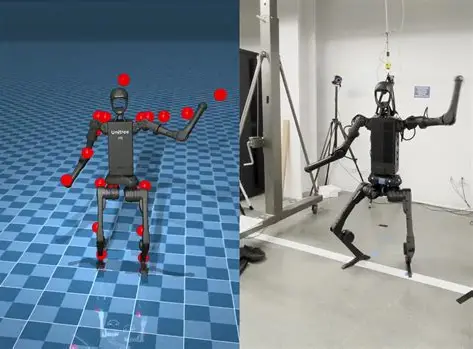
The wave-based system was demonstrated as a way of controlling a robot in real time.
Rather than relying on a conventional processor to perform every stage of the calculation before sending instructions to the robot, the physical behaviour of the waves contributes directly to the processing.
This could potentially reduce the amount of conventional computing hardware required for certain tasks.
The initial results published this month suggest that simplified neuromorphic hardware could be both small and power-efficient while operating autonomously in unpredictable environments.
A Different Direction for Physical AI
The work represents another example of research taking place at the edge of physical AI.
Much of the development of modern AI has focused on making digital models larger and providing them with more computing resources.
Wave-based computing explores a different possibility: using the physical properties of materials and waves to perform useful forms of computation.
That could be important for applications where size, energy consumption or real-time processing are major constraints.
Robots operating in unpredictable environments may need to respond quickly while working with limited power and computing resources. A physical system capable of processing information through its own behaviour could provide another possible approach.
What Comes Next
The current work remains a proof of concept, but it has already attracted attention among people following developments in robotics, materials science and unconventional computing.
The use of water waves and simulated nanoscale spin waves demonstrates that the concept can be explored at different physical scales.
Practical applications are likely to require additional research before such systems can be deployed widely.
Nevertheless, the demonstration provides another potential way around some of the limitations associated with traditional digital processors.
If wave-based neuromorphic hardware can eventually be made sufficiently reliable, compact and efficient, it could provide a new architecture for machines that need to process information and react to changing environments in real time.
The research therefore adds another possible route to the development of physical AI, where computation is not confined to conventional processors but is instead built into the physical behaviour of the system itself.