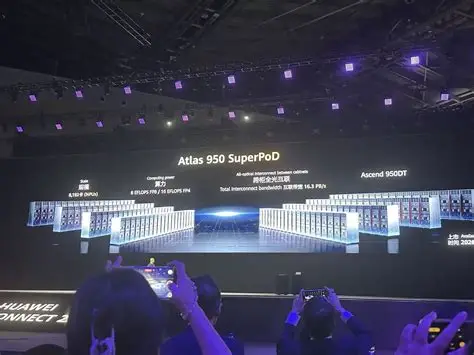
Huawei just dropped a fresh set of AI hardware that makes the global chip race feel a lot tighter than it did a week ago. On September 17, the Chinese tech giant rolled out its Atlas 960 SuperPoD computing cluster along with new chip technology and plans for future Ascend processors. The move comes as Beijing pushes harder for domestic AI capability and Western export controls continue to reshape global semiconductor supply chains.
The Atlas 960 is positioned as a faster successor to earlier SuperPoD systems Huawei showed earlier this year. The company says the new system improves computing density and interconnect performance for large language model training and inference. Huawei has also indicated that demand for its Ascend chips inside China is already exceeding available supply, at a time when many Chinese AI companies are still working around restricted access to Nvidia’s most advanced processors.
Huawei Is Moving Quickly
What stands out is the speed of the rollout. Huawei is not waiting for the usual multi-year product cycles. The firm is stacking new silicon and system designs in rapid succession, trying to close the performance gap that still exists at the absolute frontier.
The company also announced plans for the Ascend 970 and Ascend 980, with those processors currently scheduled for 2028 and 2029 respectively. That gives the latest Atlas system a place within a much wider domestic chip-development programme rather than making it a one-off product launch.
For network operators and cloud builders outside China, the announcement raises practical questions. Can Western hyperscalers keep relying mainly on Nvidia, AMD and Intel when a major alternative ecosystem is developing this quickly? Some procurement teams are already evaluating different AI hardware configurations for regions where geopolitics allow it.
Inside China, the story is simpler: state-backed data centres and private AI startups now have a clearer domestic path for scaling clusters without waiting entirely on restricted foreign hardware.
The Broader AI Chip Race
The wider semiconductor market is already feeling the pressure. Memory makers are racing to supply advanced HBM, packaging specialists are pushing new interconnect technologies, and foundries are working through increasingly demanding process transitions.
Huawei’s new systems sit right in the middle of that scramble. Whether the performance numbers hold up under independent testing remains to be seen, but the strategic signal is clear.
China is no longer content to depend entirely on foreign AI hardware. Huawei is rapidly expanding its own chips, computing systems and software ecosystem, one SuperPoD at a time.