Home AI Tools Guide for Nigerian Users in 2026
Nigerian families and small creators seeking to experiment with artificial intelligence at home now have more options than ever that do not require significant investment in new devices.
The easiest entry point continues to be cloud-based free tiers that operate in a browser or mobile application. For someone who simply wants to test what AI can do without immediately spending money, these free options provide enough room to handle many everyday tasks.
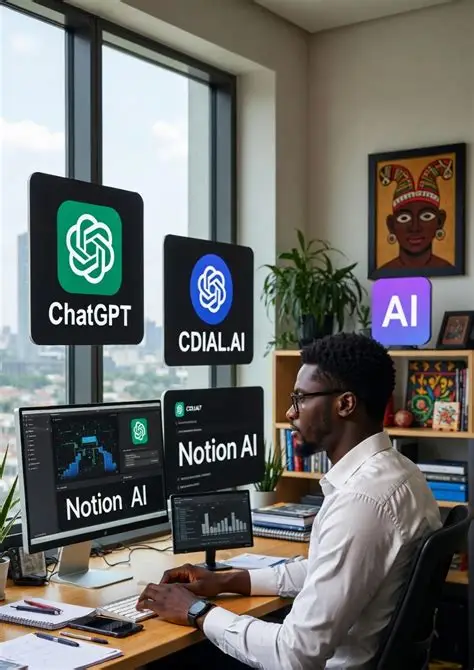
Both ChatGPT and Google Gemini remain accessible from Nigerian IP addresses and have sufficient capacity to handle writing, summarization, basic research and light coding tasks on the free plan.
Constraints apply, but for most everyday needs like drafting messages, document review or study notes, the free allocation is adequate. A student can use these tools to organize study materials, while a small creator can use them to develop ideas, clean up scripts or work through basic content tasks without buying a new computer.
Canva’s AI tools maintain their dominance in the design space, with many users having active accounts. For people who already use Canva for social media graphics, flyers, presentations or other visual work, the AI features provide a relatively simple way to introduce artificial intelligence into an existing workflow instead of learning an entirely new platform.
CapCut continues to lead the pack as a free mobile video editing application, with AI-powered captioning and effects that require no separate subscription for core functionality. This makes it particularly useful for Nigerian creators who produce short-form videos primarily with smartphones.
For users seeking greater privacy or offline capabilities, local options are maturing.
NVIDIA’s recent open-source pairing software enables households with multiple computers or gaming laptops to create a mini-cluster that distributes AI processing tasks between devices on the same network.
Some technical expertise is required, but once set up, it keeps data contained within the home network. That can be useful for people who would rather process certain files locally instead of sending everything to a cloud-based service.
The downside is that this approach is not necessarily plug-and-play for the average household. Users need compatible hardware, sufficient computing power and a basic understanding of how the devices communicate over a local network.
More practically, Nigerian innovators have been developing interesting combinations of sensors and language models to solve local problems.
A pharmacy graduate who suffered huge losses after water quality failures at his catfish farm created a working prototype using an ESP32 board, sensors and open-source models to send alerts in local languages.
The project started as a domestic initiative but is now attracting interest from other fish farmers.
That example shows where home AI experimentation can become more useful: instead of simply testing AI for entertainment, people can combine relatively affordable hardware with software to monitor real-world problems.
For most home users, the pragmatic approach remains installing a good language model application, design software and video editor, then acquiring specialized sensors only if a particular need emerges.
There is little advantage in filling a phone or computer with dozens of AI applications that perform almost the same task. A smaller setup that actually gets used is usually more practical than a long list of applications downloaded simply because they are described as AI-powered.
Payment for any upgraded plans remains simplest through virtual dollar cards funded by local bank transfers.
However, users should still check the current pricing, payment requirements and available features before paying for an upgraded plan, because AI services can change their free limits and subscription features over time.
For creators, the most useful combination may simply be a language model for writing and research, Canva for design and CapCut for video. Someone working with hardware or agriculture may then add sensors and local AI processing when there is a clear reason to do so.
The combination of free cloud-based AI tools, growing local-device options and Nigerian innovators’ projects creates more access points for average users than existed a year ago.
The challenge is to identify a genuine recurring need rather than accumulating unused applications.
AI does not necessarily require an expensive new laptop, a powerful desktop or a collection of paid subscriptions before someone can start experimenting. For many Nigerian households and small creators, the smartphone and devices they already own are enough to begin.
The smarter approach is therefore to start with the free tools, identify the tasks where they genuinely save time or solve a problem, and only spend money when the limitation becomes clear.
That keeps the cost under control while still allowing ordinary users to explore what AI can realistically offer from home in 2026.