Katalyst Launches Historic Orbital Rescue Mission to Save NASA’s Aging Swift Observatory
The commercial space industry reached another major milestone on Thursday as U.S. startup Katalyst Space Technologies successfully launched a groundbreaking orbital rescue mission designed to save one of NASA’s most valuable scientific observatories from destruction.
The mission, which experts describe as a historic test of next-generation satellite servicing technology, could extend the operational life of NASA’s Neil Gehrels Swift Observatory by several years while showcasing capabilities that may shape the future of commercial and military space operations.
NASA’s Swift Observatory Faces End After More Than Two Decades in Space
NASA’s Neil Gehrels Swift Observatory, commonly known as SWIFT, has been operating in orbit since 2004, helping scientists study some of the universe’s most mysterious phenomena, including black holes, gamma-ray bursts, and distant galaxies.
However, after more than 22 years in service, the observatory has faced an increasingly serious problem: it lacks onboard propulsion systems capable of correcting its orbit. As atmospheric drag gradually pulls the spacecraft closer to Earth, experts estimated there was a high probability that SWIFT could re-enter Earth’s atmosphere and burn up later this year.
Rather than allowing the $500 million scientific asset to be lost, NASA partnered with Arizona-based startup Katalyst Space Technologies to attempt something never before achieved by a U.S. mission. an orbital rescue operation using autonomous robotic spacecraft.
Katalyst’s LINK Spacecraft Successfully Launches Into Orbit
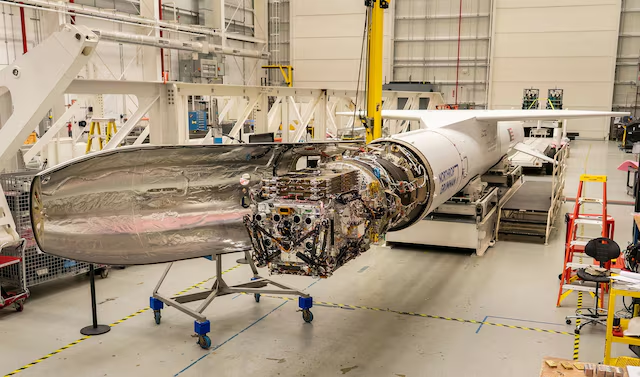
The centerpiece of the mission is Katalyst’s robotic spacecraft known as LINK, a half-ton autonomous vehicle specifically engineered to rendezvous with, capture, and tow aging satellites in orbit.
The spacecraft launched aboard a Northrop Grumman Pegasus XL rocket after being released approximately 40,000 feet above the Pacific Ocean from a Lockheed TriStar aircraft. The launch followed several delays caused by weather conditions and technical checks.
The mission began from the U.S. military installation located on Kwajalein Atoll in the Marshall Islands.
According to Katalyst, the LINK spacecraft was designed, built, and tested in just nine months under a $30 million NASA contract — an unusually rapid timeline for a mission of this complexity.
How the Orbital Rescue Mission Will Work
After reaching low-Earth orbit, LINK will spend roughly one month traveling toward the Swift Observatory.
Once it arrives near the observatory, the spacecraft will begin a carefully choreographed series of autonomous maneuvers designed to safely approach the aging satellite.
The operation will occur in several stages:
| Mission Phase | Planned Operation |
|---|---|
| Initial Approach | LINK travels within approximately 6 miles of SWIFT |
| Proximity Operations | Autonomous navigation systems guide final approach |
| Capture Phase | Three robotic arms secure the observatory |
| Orbital Transfer | LINK raises SWIFT to a safer orbit |
| Extended Operations | Additional maneuvering tests conducted |
The spacecraft is equipped with multiple thrusters, advanced sensors, and three robotic arms featuring hand-like gripping mechanisms designed to gently capture the observatory without damaging it.
Once attached, LINK will spend approximately 60 days towing SWIFT to an altitude of around 600 kilometers above Earth, effectively doubling the orbit the observatory would have occupied before re-entry.
A Major Step Forward in Satellite Servicing Technology
The mission represents the first American attempt to physically capture and reposition an operational satellite in orbit using autonomous robotic systems.
Industry experts have been closely monitoring orbital servicing technologies because they could fundamentally change how governments and private companies manage spacecraft.
Instead of abandoning expensive satellites once fuel runs low or systems degrade, future spacecraft could potentially be repaired, refueled, upgraded, or repositioned by robotic servicing vehicles.
Katalyst CEO Ghonhee Lee described the mission as a major breakthrough not only for NASA but also for the broader space economy.
According to Lee, missions that traditionally require several years of development may eventually be completed in less than one year using newer commercial space engineering approaches.
Growing U.S.-China Competition Drives Orbital Technology Development
The LINK mission also arrives amid increasing competition between the United States and China over advanced space technologies.
Satellite maneuvering and orbital servicing capabilities have attracted growing interest from military planners because many of the technologies involved have both civilian and defense applications.
China has previously demonstrated satellite rendezvous and grappling capabilities, including tests where one spacecraft physically manipulated another object in orbit. Those demonstrations raised concerns among U.S. officials about the potential strategic implications of advanced orbital maneuvering systems.
The U.S. government and military agencies have likewise accelerated investments in similar technologies, although many related programs remain classified.
Katalyst Envisions a Future Filled With Robotic Space Workers
Looking beyond the Swift rescue mission, Katalyst believes robotic spacecraft could become commonplace within the next decade.
The company envisions fleets of autonomous service vehicles continuously traveling between Earth orbit and lunar space, performing tasks such as satellite maintenance, transportation, construction, and orbital logistics.
Such capabilities could allow governments and commercial operators to purchase space services on demand rather than developing entirely new spacecraft systems for every mission.
If successful, the LINK mission may not only save one of NASA’s most important scientific observatories but also mark the beginning of a new era in orbital infrastructure, where robotic spacecraft routinely repair, move, and maintain humanity’s growing presence in space.