Ghana’s Three Accra Internet Exchanges Reveal a Fragmented Peering Market
Ghana’s internet infrastructure is expanding, but the country’s three internet exchange points in Accra remain surprisingly disconnected from one another.
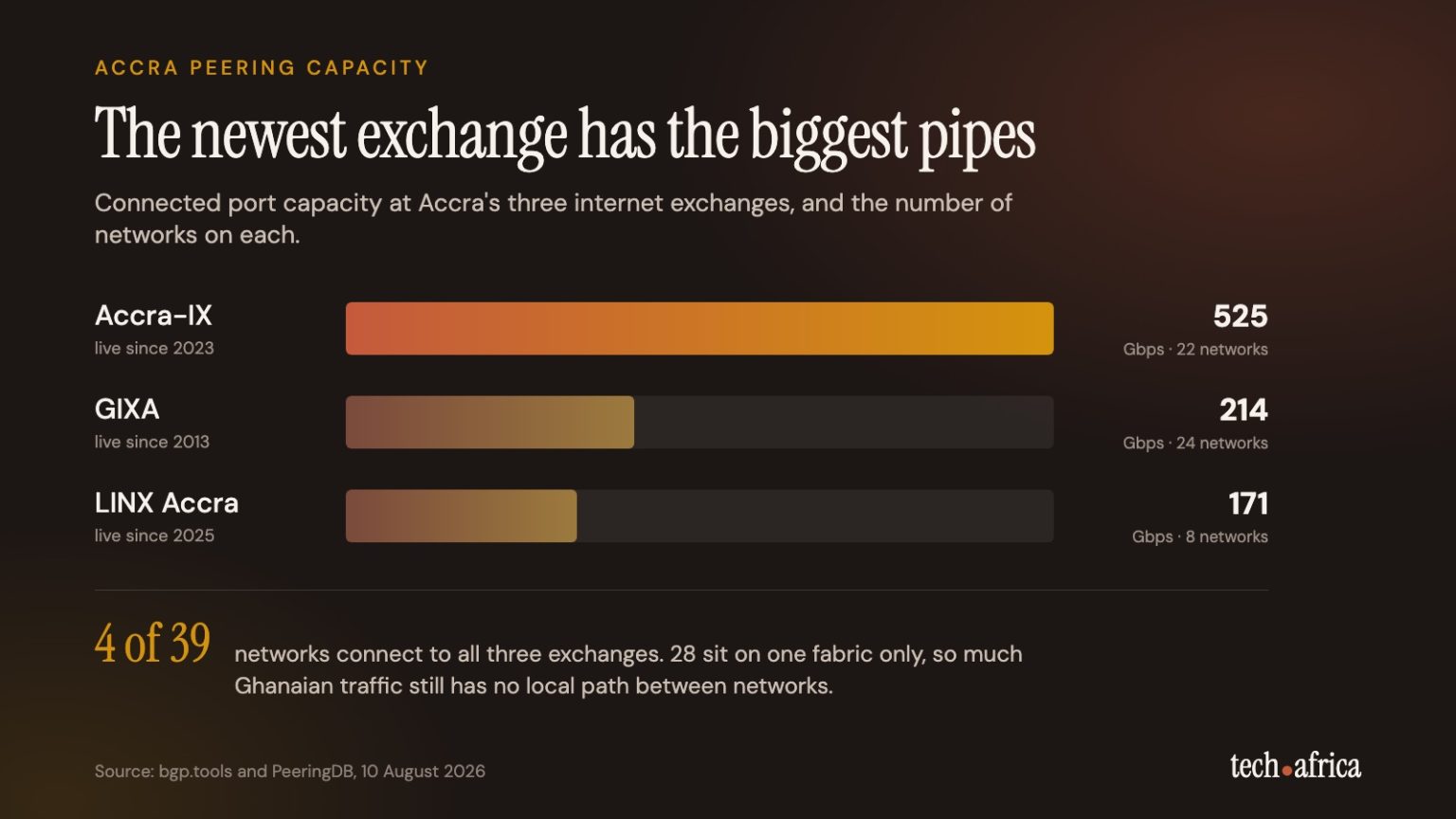
Accra-IX has announced that its aggregate traffic has surpassed 200 Gbps, supported by about 525 Gbps of connected port capacity. While that marks significant growth for an exchange launched in 2023, a closer look at Ghana’s peering landscape reveals another important figure: only four networks are connected to all three exchanges operating in Accra.
The three facilities are GIXA, Accra-IX and LINX Accra, each serving a different group of networks and content providers.
Accra-IX Crosses the 200 Gbps Mark
Accra-IX began operations in 2023 and has grown rapidly since its launch. The exchange now reports more than 200 Gbps in aggregate traffic, compared with approximately 525 Gbps of connected port capacity.
That represents roughly 38% utilisation of the available port capacity.
The capacity behind the exchange includes several high-speed connections. Public routing information shows 100 Gbps ports associated with Meta, Fastly, Scancom, which operates as MTN Ghana, and GVA of Côte d’Ivoire, alongside a number of 10 Gbps connections.
The 200 Gbps milestone therefore sits within the technical capacity already connected to Accra-IX rather than representing an unusually high utilisation level.
The bigger issue is scale. Ghana’s exchange infrastructure is still considerably smaller than some of Africa’s largest peering hubs. NAPAfrica in Johannesburg, for example, crossed the 5 Tbps traffic mark in 2025, while Nigeria’s IXPN has been moving toward 400G port capacity.
For Ghana, the current numbers point to an internet ecosystem that is growing but still developing from a relatively smaller base.
Three Exchanges, Different Membership and Capacity
Ghana’s internet exchange market has developed through three separate platforms.
GIXA, operated by the Ghana Internet Exchange Association, has been active since 2013. Accra-IX followed a decade later in 2023, while LINX Accra, operated by the London Internet Exchange, entered the market in 2025.
Their numbers are noticeably different.
GIXA has about 24 networks across 27 routers, with total connected capacity of roughly 214 Gbps. Its largest connections are around 20 Gbps, including those belonging to MTN Ghana, Telecel and Google.
Accra-IX has around 22 networks across 22 routers, but its connected capacity is substantially higher at approximately 525 Gbps.
LINX Accra is smaller by membership, with eight networks and about 171 Gbps of connected capacity. Much of that capacity comes from a 100 Gbps Meta connection.
The figures show that Ghana’s exchanges are not simply competing as larger and smaller versions of the same service. Each has developed its own combination of networks, providers and content platforms.
Google, Akamai and Fastly Are Split Across Exchanges
The fragmentation becomes more significant when looking at major content and cloud networks.
Google and Akamai connect to GIXA but not the other two Accra exchanges, while Fastly connects to Accra-IX alone.
Meta has a broader presence, connecting to all three exchanges. It also has 100 Gbps connections at both Accra-IX and LINX Accra.
That distribution matters to internet service providers.
For example, an ISP connected only to Accra-IX does not automatically have a direct local peering route to Google or Akamai through the Accra-IX fabric. Without another connection or peering arrangement, traffic destined for those networks may have to travel through an upstream transit provider.
One of the major benefits of internet exchanges is precisely to reduce that dependence on paid transit by allowing participating networks to exchange traffic directly.
GIXA also hosts several important measurement and research networks, including Packet Clearing House and the University of Oregon’s Route Views project. Ghana’s academic and research network is connected there as well.
MainOne also peers through GIXA rather than Accra-IX.
The mobile operators are similarly divided. MTN Ghana has connections at both GIXA and Accra-IX, with 20 Gbps at GIXA and 100 Gbps at Accra-IX. Airtel Ghana, meanwhile, appears on GIXA alone.
Only Four Networks Connect to All Three
Across the three Accra exchanges, there are 39 distinct networks.
However, only four networks appear on all three platforms: Meta, AFR-IX Telecom, Broadspectrum and The Cloud Network.
At the other end of the spectrum, 28 networks are connected to only one exchange.
That limited overlap is one of the clearest signs that Ghana’s internet exchange ecosystem remains fragmented.
Two local networks can therefore be connected to an internet exchange in Accra while still having no direct peering relationship with each other if they use different exchanges.
In such cases, traffic that could potentially remain within Ghana may instead have to pass through an upstream transit provider. Depending on the routing arrangement, that traffic can potentially leave the country before returning.
Connected Capacity Does Not Equal Traffic
The available figures also need to be viewed carefully.
The membership and port information used to assess the three exchanges reflects connected infrastructure and routing data. It shows which networks are connected and the capacity of their ports, but it does not necessarily show how much traffic is actually flowing through those connections.
This distinction is particularly important when comparing the 525 Gbps connected capacity at Accra-IX with its reported 200 Gbps aggregate traffic.
The two numbers describe different things.
A connected 100 Gbps port, for instance, provides the ability to carry traffic at that rate. It does not mean the network is continuously transmitting 100 Gbps.
There are also differences between exchange operators’ own membership figures and routing databases. GIXA lists 23 connected networks on its platform, while Accra-IX lists 26. The routing figures used for comparison put the numbers at 24 and 22 respectively.
Those differences make independent routing and peering data useful when examining the broader structure of Ghana’s exchange market.
Ghana’s Internet Growth Faces a Peering Fragmentation Challenge
Having three internet exchanges in Accra is not necessarily a problem. Competition can encourage investment, improve infrastructure and give networks more choices for connecting locally.
Accra-IX’s rapid growth demonstrates that newer infrastructure can attract substantial capacity, while the arrival of LINX adds another major international exchange operator to Ghana’s market.
The bigger question is how effectively these separate exchanges connect Ghana’s internet ecosystem together.
With 28 of the 39 identified networks appearing on only one exchange, a large portion of the market remains tied to individual platforms. Only four networks have a presence across all three.
That means the number of exchanges alone does not tell the full story of Ghana’s local internet development.
The more meaningful measure would be how much traffic generated within Ghana is exchanged locally and remains inside the country rather than being sent through international or external transit routes.