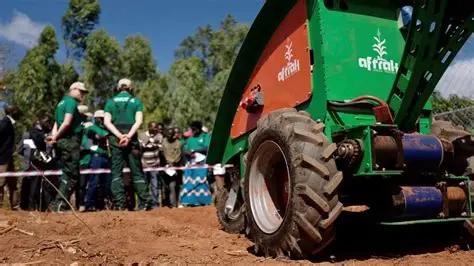
Aftrak, a Loughborough University spin-out developing an agritech solution for smallholder farming communities, has secured new funding through the UK’s DRIVE35 Mobilise programme.
The project combines solar microgrids with specially designed micro-electric tractors and a farming method known as Deep Bed Farming.
Its goal is to increase agricultural productivity while also creating access to clean electricity for local communities, bringing food production and renewable energy into the same system.
The model is designed around a cycle in which increased farm yields help generate income that can then support electricity use from the local microgrid.
Combining Solar Power With Electric Tractors
Aftrak’s system brings together several technologies rather than relying on a single agricultural intervention.
Solar arrays are used to charge batteries that power the micro-electric tractors. The tractors can then be used by smallholder farmers as part of the farming system.
At the same time, Deep Bed Farming is intended to increase agricultural yields.
The increased productivity is important because it creates an economic link between farming and the electricity system. As farmers produce more, they can potentially generate additional income that can be used to purchase electricity from the microgrid.
This creates what the project describes as a virtuous circle in which clean energy supports farming, while increased agricultural production helps sustain demand for the electricity system.
Early Trials Show Higher Yields
Initial trials have suggested that yields can be increased by three times while household incomes can also be significantly improved.
The project has already attracted major recognition, having previously received the $1 million Milken-Motsepe Prize in Green Energy.
The combination of agricultural productivity and renewable electricity is central to the project’s approach.
Rather than treating electricity access and food production as separate problems, Aftrak is attempting to address both through one integrated system.
That approach is particularly relevant in communities where farmers need access to better agricultural equipment while households also require dependable electricity.
Loughborough Engineers Among the Co-Founders
Engineers from Loughborough University, the Consortium for Battery Innovation and the international development charity Tiyeni are among the co-founders of the venture.
The new funding is expected to accelerate the deployment and further testing of the technology.
The system is already being deployed in Malawi for additional trials, providing an opportunity to assess how the approach performs in practical conditions.
The additional investment can therefore support the next stage of development while helping Aftrak expand the introduction of its agricultural and energy technology.
Why the Model Combines Two Major Needs
One of the most notable aspects of Aftrak’s approach is the way it connects farming productivity with energy access.
Agricultural communities can require better machinery to increase productivity, but conventional agricultural machinery can also depend heavily on fuel and other inputs.
Aftrak’s system instead uses solar power to charge batteries for electric tractors.
At the same time, the increased agricultural output is intended to provide farmers with additional income.
The result is a model that links renewable energy, agricultural machinery and food production rather than treating each challenge independently.
Funding Could Accelerate Further Deployment
The new DRIVE35 Mobilise funding gives Aftrak an opportunity to build on its existing trials and accelerate deployment.
With the technology already being tested in Malawi, the next phase can provide further information about how the system performs in real farming environments.
Those following distributed energy and agritech applications have been paying attention to the project because of its potential to address electricity and food-security concerns at the same time.
Aftrak’s development therefore sits at the intersection of clean energy and agriculture, with its microgrids, electric tractors and Deep Bed Farming approach designed to work together as one system.
If the model continues to demonstrate the results seen in its initial trials, it could provide another example of how renewable energy can be integrated directly into agricultural development rather than being treated as a separate infrastructure project.